
April 15, 1997
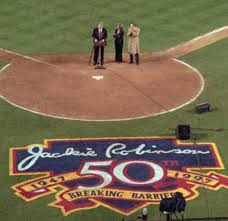
This was the day that the legendary Jackie Robinson’s number was retired by all of Major League Baseball. It was the 50th anniversary of Robinson’s big league debut for the Brooklyn Dodgers and of him becoming the first African-American since the 19th century to play in an integrated, top-level baseball game. During a telecast of “Sunday Night Baseball” between the Dodgers and the Mets at Shea Stadium in New York, then-baseball commissioner Bud Selig made his way out onto the field. He was flanked by Rachel Robinson (Jackie’s widow) and president Bill Cllinton, who was nursing a knee injury at the time. In front of the thousands in attendance and the millions watching at home, Selig made the announcement that Robinson’s uniform number 42, would be retired throughout the whole league. In other words, there would never be another major league baseball player who would don the sacred number again. Many spectators were shocked as the MLB tried their absolute best to keep news of the proclamation under wraps for fear the media would ruin the surprise. Exceptions were made for players who were already wearing the number at that time, and a select number of players were allowed to continue wearing 42 until they retired. A young Yankee closer named Mariano Rivera (you may have heard of him) continued wearing Robinson’s number for another 16 years before finally retiring in 2013. Since then, no professional baseball player has worn the famous figure and none other ever will.
Robinson’s number was the first one to be retired by an entire major sport in America (although, in the years after, the NBA has withdrawn Bill Russel’s #6 and the NHL has made Wayne Gretsky’s number #99 off limits as well). The mentality of the MLB in 1997 was that for as long as the league was around, Robinson’s number was to be the only one ever retired throughout the whole sport. Meaning that if people are still playing baseball 300 years from now, number 42 would continue to be the only number immortalized. The rationale was that there was not and would never be another player that even came close to the trailblazer Robinson was. Never another man whose character matched that of the late barrier breaker and never another individual whose significance to the game itself, and the communities around him could even be mentioned in the same breath as the man who wore number 42. Who would be worthy of an accolade equal to Robinson’s? To be memorialized in the same way he has been? To have the same impact on scores of people as the Brooklyn Dodger great? Well, as things turn out, there may have been one other man………
Roberto Clemente: The Baseball Superstar
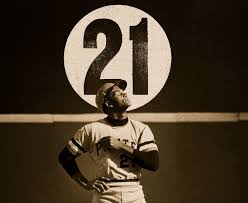
Roberto Clemente Walker. The full name of the Pirates’ legend contains 21 letters in total. That is the very simple reason why he chose this as his permanent number early in his rookie season. It’s a number that is synonymous with baseball superstardom and with a man that could seemingly do it all on the diamond. “The Great One’s” career statistics would make even the most accomplished player blush. There truly is no way to describe Clemente’s prowess on the field adequately. Instead, allow me to simply list many of his all-time numbers. He finished with a .317 batting average and 3,000 hits right on the dot. He scored over 1,400 runs and drove in over 1,300 more. He was selected to 15 all-star games and won 12 gold glove awards (including 12 consecutive ones). He was a four-time National League batting champion and the senior circuit’s Most Valuable Player in 1966.
Clemente also led the National League in outfield assists five times, and has the second most by any right fielder who ever lived. As Vin Scully said, “He could field the ball in New York, and throw a guy out in Pennsylvania.” He hit 166 triples in his career, an amount that will almost certainly never be matched by any modern baseball player. He was a two time World Series champion, winning MVP of the 1971 fall classic. These stats are even more astounding considering he could have easily played two or three more full seasons had he lived longer. He was the game’s ultimate five tool player because he could hit for average, hit for power (over 200 home runs), had speed on the basepaths, was an expert fielder, and had one of the best outfield arms the game has ever seen. Pitchers struggled to fool him because he could catch up to nearly everything they threw, even balls way outside of the zone. Simply put, Roberto Clemente was among the most complete baseball players in baseball history. MLB commissioner Bowie Kuhn stated, “He gave the term ‘complete’ a new meaning. He made the word ‘superstar’ seem inadequate. He had about him a touch of royalty.” He was a national hero in his native Puerto Rico and most still consider him the greatest ever player from the island. He is also regarded by consensus as the most significant Pittsburgh Pirate in history, too. However, as good as “Arriba” was on the field, perhaps his greatest legacy is the second life he lived away from baseball, an existence that was dominated by a never ceasing call to help those in need, wherever they may be. Let’s now take a look at the other side of this incredible man by first exploring the remarkable influence his parents had on him growing up.
Roberto Clemente: The Child
Clemente came from very humble beginnings in San Anton, Carolina, Puerto Rico, a very small town. He was one of eight children born to Melchor and Luisa on August 18, 1934. His family lived in relative poverty, but, because of their hard work, his parents were able to afford the basic necessities for their kids. Melchor worked long hours on a sugar cane plantation while Luisa worked a number of jobs, including as a laundress, and as the cook for the men working on said plantation. A young Roberto appreciated the fact that, despite their financial situation, his family always had clothing and never went without food on the table. His parents instilled in him some of the most important values in life: discipline, hard work, loyalty, and, of course, putting others before yourself. The lessons that were taught to him in his youth never left Clemente and, once he had some money from his baseball salary, he made sure the final mentioned value was the one he lived by the most.
Roberto Clemente: The Lifelong Humanitarian
Even though he became a bona fide celebrity in the mid-50s when his baseball career began, Roberto Clemente never forgot his humble roots and where he came from. He never truly moved out of his homeland of Puerto Rico, and would spend his entire offseason with his family on the island that he grew up on. He could have bought and lived in a mansion somewhere in New York, Los Angeles, or even an affluent suburb of Pittsburgh, but he decided to raise his sons in the commonwealth that he had such pride for. As he once said, “There is nothing wrong with our home, our country, that a little more care, a little more concern, and a little more love won’t cure.” During these offseasons spent on the “island of enchantment”, Clemente’s main priority was hosting baseball clinics for underprivileged children. These clinics were free of charge to their families, and at no point did he ever accept compensation for his instruction. Clemente could have capitalized on his talent and his brand name to make more money in the winter and increase his net worth, but he focused on his passions for the game and the youth over any monetary matters.
Speaking of finances, Clemente was also known for giving economic aid to many families in the Dominican Republic. He could have simply focused his benevolent generosity on people in his homeland. Instead, he recognized the need in other Latin American countries and did whatever he could to help their residents. Ok, but what about his yearly salary with the Pirates? Surely he must have been swimming in money. Completely adjusted for inflation, he made less than $1 million dollars a year by today’s standards. While he certainly wasn’t living in poverty, “Number 21” was nowhere near the top echelon of highest earning baseball players in his day. Many who were not nearly as talented as him, ended up making a significant amount more than Clemente. There were no contract disputes, no complaining for raises, and no holdouts. All he wished for was to play in Pittsburgh his entire career and use whatever money he did earn to help his family and impoverished communities everywhere. Oftentimes, in order to increase their revenue, sports stars sign autographs for fans and charge high prices. Clemente put his signature on thousands of baseballs, mostly for children, for no charge at all. Many modern baseball players limit the amount of autographs they sign in order to increase the value of their signature. Not Roberto Clemente. He was known to never refuse an autograph request from a child.
When the Pirates organized a special game in tribute to him in 1970, he asked that the proceeds from the game be donated to Pittsburgh’s Children’s Hospital, an institution he would visit frequently. It was said that if any child in his native Puerto Rico needed food or medicine, Clemente would move heaven and earth to make sure they received it. Instead of setting his sights on a lucrative business venture in retirement, he set his sights on opening and operating a sports center for underprivileged youth in Puerto Rico, and considered making the blueprints for it one of his greatest accomplishments in life. Pirates’ general manager Joe Brown said, “I don’t think Clemente turned down many people who wanted his help, if anybody.” To sum up all of the good he did for people in need, I will let the man, himself, have the final words for this section: “Any time you have an opportunity to make a difference in this world and you don’t, then you are wasting your time on this earth.”
Roberto Clemente: The Civil Rights Advocate
However, Clemente didn’t focus all of his attention on charitable work with the poor. He also was a symbol of racial equality and a champion of civil rights. To start, when he was a young baseball player in the ‘50s, Clemente faced antagonism from fans, opposing teammates, and especially the sports media. The media tried to portray him as fiery and unstable because he would stand up for himself in front of them, and they would call him mean when he threw the occasional insult their way (which they deserved). He also faced prejudice in his personal life. In one of the final interviews he ever gave in 1972, he spoke of an experience furniture shopping. The owner of the store, not realizing who the baseball superstar was, refused to show Clemente any of their more expensive merchandise. The reason being that, by virtue of being hispanic, it was assumed that he wouldn’t be able to afford it. Roberto Clemente could have responded to the negativity and aggression he faced with anger and malice. He could have thrown punches and started fights. Instead, he stood up for himself in a strong, but civil way. His model behavior won the respect of many within the game of baseball, and helped paved the way for more Latin American players to join the MLB in the ‘50s and ‘60s. Essentially, Clemente was baseball’s first Latin American personality and, much like Jackie Robinson a decade prior, carried himself with dignity and class.
It wasn’t just himself and other Latin Americans that Clemente stood up for, though. He became a close friend of Dr. Martin Luther King, Jr and they shared a series of meetings in Puerto Rico. Clemente was known for sticking up for the rights of African-Americans everywhere. During spring training (which took place in the South), he would refuse to enter any establishment that had segregationist policies, even when they were willing to accept him as a hispanic man. He called for more black players to receive major endorsements and sponsorships, and even persuaded the Pirates to postpone their scheduled game the day of King’s assassination. Roberto Clemente showed many times that he was not afraid to speak out against any injustice, no matter who the victim was. Despite the discrimination in America he both faced and spoke out against, these experiences never stopped him from loving his adopted country.
Roberto Clemente: The Private First Class
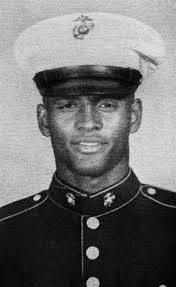
While never abandoning his native Puerto Rico, Clemente also grew to be passionate about the ideals of the United States. So strong was his love for America, that in his “spare” time he joined the US Marine Corp Reserve in 1958. As part of the reserve, he attended basic training at Parris Island, South Carolina and infantry training at Camp Lejeune, North Carolina. His title was private first class, and, at the time, he broke the Marine Corps Reserve record for the most chin-ups in a row, as well as for the fastest obstacle course time, putting his baseball strength and conditioning training to good use. This was not simply a one-time, publicity stunt situation. Clemente continued to serve in the reserve each offseason until 1964. In 2003, he was elected into the Marine Corps Reserve Hall of Fame. In the offseason, “Arriba” could have relaxed, taken a break, and put his feet up like so many other players. Instead, he put his admiration for his new country into action, and was willing to serve it any way that he could.
Roberto Clemente: The Advocate for Nicaragua and His Sad Death
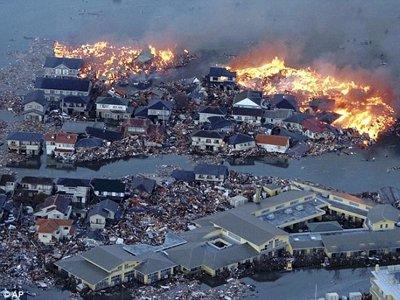
Then came Clemente’s largest humanitarian undertaking. On December 23, 1972, a magnitude 6.3 earthquake struck in the Central American country of Nicaragua. Nearly 11,000 people lost their lives and over 30,000 became homeless. Clemente felt such a call to help the many people affected by this natural disaster, that he devoted much of his time, effort, and finances to relief efforts. He began going door to door in San Juan asking for donations of any kind to send to the ailing people in Nicaragua. He barely slept and refused to open his Christmas gifts as an act of solidarity to those who had their lives displaced by the earthquake. So, why did Clemente drop everything to help Nicaraguan citizens? Was it because he, himself, had just visited the country while serving as manager in the Amateur World Series (yes, he did that, too)? Was it that he had a passion for helping Latin Americans in general? Or was it because there was a crisis and Roberto responded the only way he knew how (just as he had done all of his life)?
Whatever his rationale, Clemente coordinated supply deliveries to be flown into Nicaragua’s capital, Managua. Why flown and not sent in by ship? With the rampant corruption of the Nicaraguan government, he feared these supplies might fall into the wrong hands if they were shipped and had to face a customs port. However, flying in supplies didn’t seem to be yielding a different result. Between December 24th and December 30th, Clemente organized three separate flights into Managua to deliver his collected necessities. On each of these three voyages, corrupt Nicaraguan officials had confiscated all donations. It was at this moment that Clemente could have resigned himself to the fact that the crooked powers that be in Nicaragua would never allow any of the supplies he collected to actually be taken to the Nicaraguan people. He could have given up right then and there. If he did, he might have played two more seasons, won another gold glove, collected more hits, and contended for another World Series. He might have built more sports complexes, visited more sick children, and may have led relief efforts for other natural disasters. Heck, he may have still been alive today as a 91-year old baseball ambassador.
However, giving up instead of ministering to those in need was not in Roberto Clemente’s philosophy. So, he arranged for a fourth trip. This time he would be personally accompanying the flight. He reasoned that the shady officials in Managua wouldn’t deny the donations if a Latin American icon was there to have an in-person conversation with them. On December 31, 1972, he boarded a very crowded supply plane bound for Central America with a team of four others. The plane itself was overcrowded and had a history of mechanical issues. Clemente’s story sadly ends with that very plane crashing into the Atlantic Ocean shortly after takeoff. Despite many diving efforts, his body was never recovered. Roberto Clemente had died doing the very thing he loved the most: helping those in need. He was only 38 years old.
Aftermath
The Baseball Hall of Fame responded by making an exception they had only done for Lou Gehrig 34 years earlier. They waived their five-year retirement stipulation and immediately voted Roberto Clemente into Cooperstown in March of 1973. He became the first player born in Latin America to be enshrined in the hall. President Richard Nixon posthumously bestowed him with the very first President’s Citizens Medal and Congress awarded him the Congressional Gold Medal. With the help of Nixon’s administration, The Roberto Clemente Organization was set up in his honor. Donations to this institution went directly to support victims of the Nicaraguan earthquake, so that they could finally receive the help Clemente so vigorously fought for. Also, with the help of private donors and his wife, Vera, Clemente’s vision for his center for sports in Puerto Rico became a reality and would serve the island’s youth for decades to come. Remembrance of Clemente, however, is not simply left in the past, as there are many initiatives in modern times that have been influenced by “The Great One” as well.
Roberto Clemente: The Modern Influence
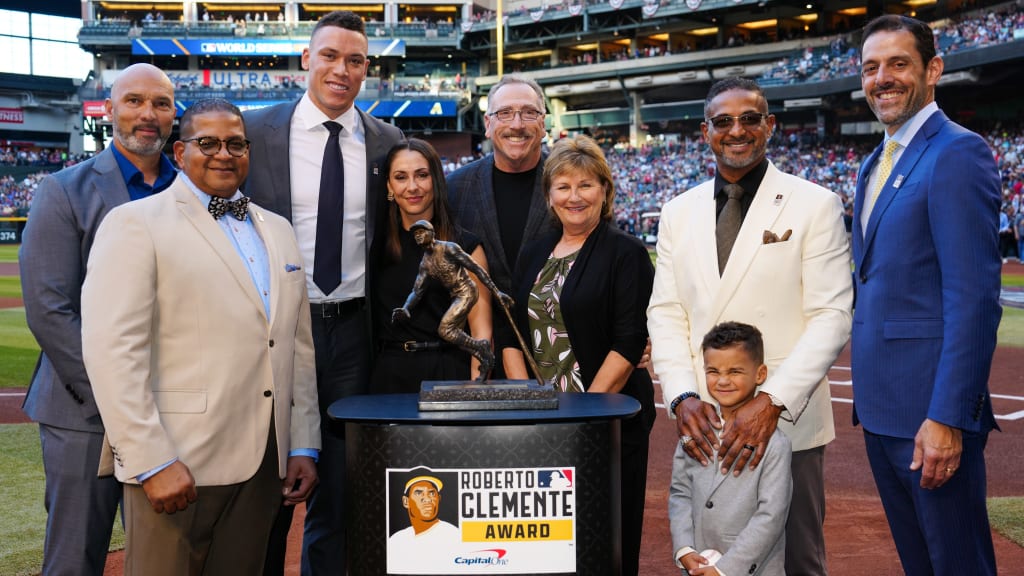
Clemente’s legendary number 21 has been retired throughout all levels of Puerto Rican Baseball from youth leagues to professional teams, as well as throughout the entire Pittsburgh Pirates organization. Each September, Major League Baseball also celebrates Roberto Clemente Day. In the context of Hispanic Heritage Month, many players across all teams are able to wear his number 21 on this occasion and most ballparks prepare some kind of tribute for the man who gave his life helping others. Then, there is the Roberto Clemente Award. Renamed from the Commissioner’s Award, this honor recognizes one player in baseball “who best represents the game through extraordinary character, community involvement, philanthropy, and positive contributions both on and off the field.” Each team nominates a player and the winner is revealed just prior to Game 3 of the World Series. Past winners include Willie Stargell (Clemente’s teammate on the Pirates), Pete Rose, Cal Ripken Jr., Dave Winfield, David Ortiz, and Derek Jeter. A few of the most recent recipients are Aaron Judge, Salvador Perez, and Mookie Betts. However, scores of people still feel that the MLB should go one step further. A path they have only gone down once, almost 30 years ago with Jackie Robinson. Let’s now take a look at efforts to have Clemente’s number retired by all of MLB.
21: The League-Wide Retired Number?
In the 29 years since Jackie Robinson’s number was universally retired that fateful Sunday night, there have been a number of attempts and calls for Major League Baseball to follow suit and retire Roberto Clemente’s number 21 across all teams and at all levels. For starters, the Pirates’ organization has, themselves, gone to the MLB a number of times with this request. A special event was even held in 2006 when Pittsburgh hosted the All-Star game to promote this concept. Julio Pabon (the founder of Latino Sports) and Puerto Rican activist Willie Soto have been two of the most vocal voices from outside of the MLB to push Clemente’s number to be retired, as well as Byron Hunter, the award winning producer of the series “The Legacy of 21.” New York representative Adriano Espaillat has even tried to introduce legislation to pave the way for 21 to be immortalized in every baseball stadium.
However, none have pushed for this initiative as hard as Roberto Clemente’s immediate family. His widow, Vera and sons Luis and Roberto Jr have petitioned for years that commissioners Bud Selig and now Robert Manfred make Clemente’s number the second one retired by all of baseball. However, as of the current moment, both commissioners haven’t seriously looked into making that a possibility. Some say the reason is because the promise made to the Robinson family, and Rachel in particular, (who is still living at the ripe age of 103!) that number 42 would be the only league-wide retired number. Other critics bring up the risk of “opening the floodgates” and if baseball were to retire a second number, it could lead to the sport having dozens more off-limits one day. Despite these detractors, the efforts by fans, friends, and family of Clemente continue. It’s also not only spectators of the game that believe 21 should be immortalized, because many inside of the modern game share this same sentiment. In the past decade, baseball stars Yadier Molina, Carlos Beltran, and David Ortiz have all publicly supported this number retirement. Current Red Sox manager Alex Cora has come out in support as well. Also, just last year, Astros manager Joe Espada stated “What Roberto Clemente has done, what he represents, what he did to open the doors to a lot of people like me. It (number 21) should be in every corner of every major league stadium.”
21: Should It Be Retired?
So, our essential questions remain: Has Roberto Clemente’s significance to baseball, our culture, and America been important enough to enshrine his number in all 30 MLB ballparks? Could you really put him on a similar plateau as Jackie Robinson? Should a second man have his jersey number retired by all of major league baseball? Regardless of how you, personally, feel, no one can deny that Clemente was an example of a human life that was lived at its fullest. In fact, there have even been some efforts to make him a saint in the Catholic Church (but that’s another rabbit hole for another time). He broke barriers for Latino players, withstood rampant racism, visited sick children, taught the poor, and gave himself to every cause he could find, a philosophy that ultimately cost him his life. Many Hispanic communities look up to him in a very similar way that African-American circles view Robinson.
He was the example of a true, honest, and hard-working man that any of us, no matter what background we come from can strive to emulate. He defined what it meant to truly put others before oneself. A “celebrity” who didn’t embrace stardom, but humbled himself to work with the most impoverished communities and with the most in-need citizens. A man who touched every life he came into contact with and a human being who was a leader in every sense of the word. As his good friend and Pirates teammate, Manny Sanguillen stated, “Roberto Clemente played the game of baseball with great passion. That passion could only be matched by his unrelenting commitment to make a difference in the lives of the less fortunate and those in need. People saw Roberto as a great ballplayer and humanitarian. He was also a great father, husband, teammate, and friend.” Surely, if there was a ballplayer that ever existed who could have matched Robinson’s influence and example, it was Roberto Clemente Walker.
 Yankee In Exile
Leave a comment