
A Super Bowl Name Origin Story
What’s In A Name?
The Super Bowl is easily the most popular sporting event in North America. Last year’s (2025) edition set a record with 127.7 viewers across all television and streaming platforms. It’s not always the action on the field that’s the attraction either, with the halftime show and new commercial debuts becoming very popular to watch in the past couple decades as well. However, at the center of this big Sunday night in February is the Pro Football Championship Game and the players, coaches, and officials that take part in it. So, how did this colossal tilt get its name, and why is it called the “Super Bowl?”
If I’m being honest, the name for the biggest game in football sounds as if it came straight off the schoolyard playground, where children play pick-up games of two hand touch. It seems as though the concept for this name could have been the brainchild of a 2nd grader. Surely, a more creative and mature name could have been chosen for a game of this magnitude? As we are about to find out, sometimes things resonate better the simpler they are and, occasionally, adults do take inspiration from the musings of elementary school children.

Created in 1964
The Old NFL
For the first 46 years of its existence (1920-1966), the National Football League (NFL) had its own football championship named, rather creatively, the NFL Championship. The two teams with the best records at the end of the regular season would qualify to play in the game. In this era, the Green Bay Packers won 8 NFL Championships, the most of any team. Not to be outdone, the Chicago Bears were also kings of the league on 7 different occasions. The next most successful teams were the Giants, Lions, and Browns who all had 4 titles each. Many teams that history has forgotten also took home NFL crowns during this time. These included the Akron Pros (who won the very first championship), the Providence Steamroller (hosts of the NFL’s inaugural night game), Frankford Yellow Jackets, and Canton Bulldogs.
However, after 40 years of being the only main game in town, in 1960 the NFL finally had some competition in America. This opposition came in the form of the new American Football League, or AFL for short. This fledgling federation began when wealthy businessman Lamar Hunt was denied the opportunity of establishing an expansion NFL franchise in his hometown of Dallas. Hunt decided that if he couldn’t own an NFL team, he’d found an entire league to compete against them.
The AFL: A Success Story
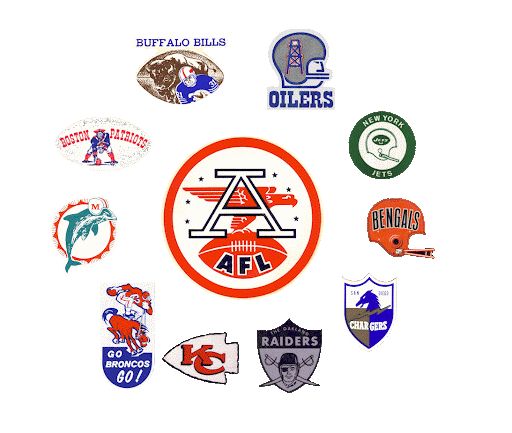
The AFL did well. Very well. Better than anyone thought it ever would. The new league gave us some teams that I’m sure you will recognize. These include the Houston Oilers, Buffalo Bills, Boston Patriots, Denver Broncos, Los Angeles Chargers, Dallas Texans (Cowboys), New York Titans (Jets), and Hunt’s own Kansas City Chiefs. Lamar Hunt’s association appealed to younger audiences due to it being a more pass happy and fast paced brand of football than the run and defense dominated NFL. It also gave us modern concepts like the two-point conversion, players’ last names on the backs of jerseys and, perhaps most significantly, the sharing of ticket and television revenue by home and visiting teams. In no time at all, this startup competition secured a contract with a major television network (NBC) and began drawing millions of fans to its stadiums each season.
The symbolic high point for Hunt’s brainchild came in 1965 when, in an unprecedented move, superstar Alabama quarterback Joe Namath chose to forgo playing for the NFL’s Cardinals and, instead, sign a then-record contract to suit up for the New York Jets. Up to that point, the AFL mostly signed players from small colleges. Lamar Hunt wasn’t just competing with the National Football League, in just five short years, he had built a union of teams that served as a major alternative to the senior league’s style and variety of football. With both sides doing well, and the AFL becoming a juggernaut, the question begs: Why merge? How would that benefit the upstart American Football League? What advantages would either federation gain? Well, as it turns out, there were many good reasons to combine both leagues.
The Merger
As much as the competition of having two major football leagues in America was great for fans, it wasn’t so profitable for the leagues themselves. Both the NFL and AFL faced increased tension when it came to vying for veteran players and college talent via the draft (Joe Namath). Also, any non-tampering agreements that were made between the associations had failed miserably. This was most evidenced in 1966 when the NFL Giants signed kicker Pete Gogolak away from the AFL Bills. In addition, both leagues felt that their television networks (CBS for NFL and NBC for AFL) kept lowballing them on production contracts. They thought a united front would pave the way for much more lucrative TV deals. The merging of fanbases also likely meant more profit as well as a larger sharing of revenue. Likewise, a common draft would mean the end of competing for talent.
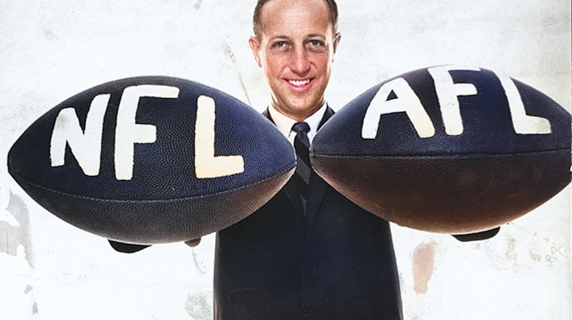
To sum this all up, the NFL and AFL were costing each other money and it was getting to the point where executives from both leagues believed merging would make everyone better financially. So, on the evening of June 8, 1966, NFL Commissioner Pete Rozelle (who was still just 40 years old) and Lamar Hunt made the announcement. The two leagues would be merging under the common name of NFL. The merger would take slow steps in some cases, as this new “NFL” would be split up into two different conferences. One conference would be made up of teams from the “Old NFL.” The other conference would be composed of past AFL squads. Each conference would have their own, separate schedules, and teams from different conferences would not play each other during the regular season. As for the postseason, well that was something else entirely…….
January 15, 1967
That same night in early June of 1966, Rozell and Hunt announced that, at the conclusion of each conference’s league season, the winner of the AFL and winner of the NFL would play each other in one, final game on the above date. This contest was a key requirement of the merger. It would be the very first time teams from opposite federations had ever met and the venue was later set at the historic Los Angeles Memorial Coliseum. There was just one problem left: what would the name be for this gigantic event? Surely, a matchup of this magnitude needed a name that befitted it. But, what would be an appropriate title? Well, as it turns out, the execs of this new conglomeration had significant trouble with this small matter. Rozelle suggested the game be called “The Big One” (could you really imagine calling it that?). “The Pro Bowl” was another early title that was thrown around and later used in another context. Somehow even less original than those was “The World Series of Football” but, after serious consideration, the name was scrapped due to it being too similar to baseball’s fall classic. As the summer of 1966 rolled on, the most important football game in history still had no epithet.
The Super Bowl???….. What A Stupid Name
In July of 1966, Hunt gave an interview at Chiefs training camp with Kansas City Star sports editor Joe McGuff. While being asked about the site of this big matchup coming up in January, he uttered a 27 word answer which the media never forgot. “I think one of the first things we’ll consider is the site of the Super Bowl. That’s my term for the championship game between the two leagues.” Hunt always attributed this name idea to a Freudian slip. His story was that he had recently been watching his son, Lamar Hunt, Jr., play with his favorite toy, Wham-O’s Superball. In fact, since their 1964 debut, Superballs had been one of the best selling toys in the country and a favorite under Christmas trees in 1965. So, that’s it? Lamar Hunt names this colossal venture after a 60s children’s plaything and the rest is history? Well, not exactly. NFL bigwigs hated the name and refused to use it. Even Hunt, himself, wrote to Rozell, saying “I have kiddingly called it the ‘Super Bowl’ which can obviously be improved upon.” However, what was the administrators’ in the National Football League’s better idea? Let’s find out.
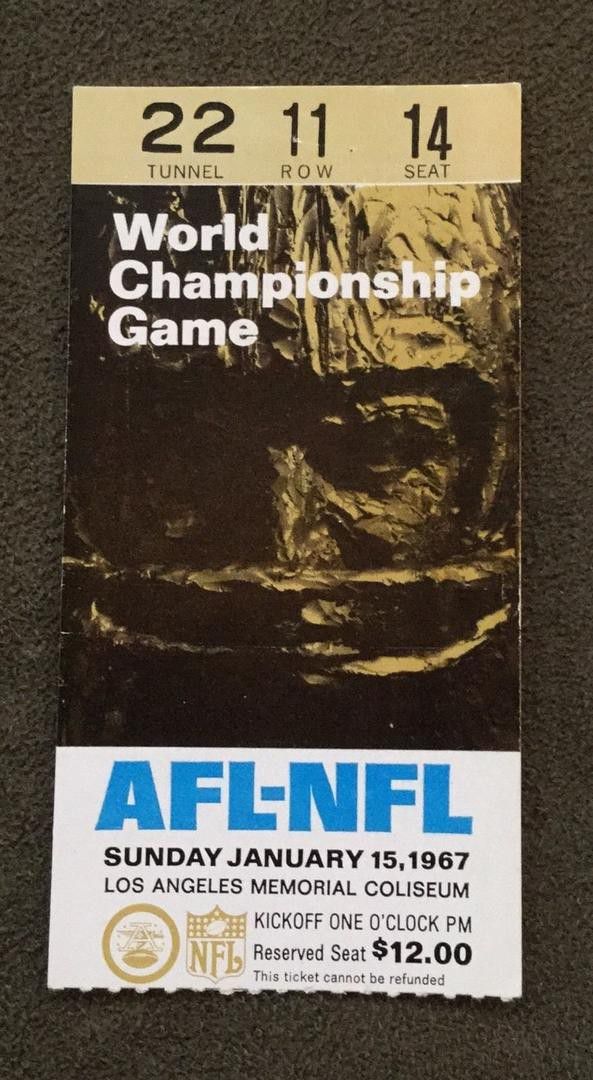
The AFL-NFL World Championship
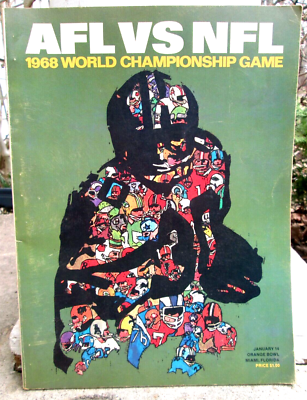
Yes, that is the name that was finally chosen in the fall of 1966. After months of deliberation and an outright rejection of Hunt’s original idea, the powers that be in the NFL chose this moniker to commemorate the upcoming tilt between the two conferences. Here’s the problem, the press fully shunned the title and advertised it as the “Super Bowl” instead. In fact, most major media outlets in the country had been calling the game by that name since Hunt’s July interview. Hunt’s title was simple, catchy, and much easier to market. However, the National Football League powered on with its created name and, in January, the Green Bay Packers won the inaugural AFL-NFL World Championship by beating the Kansas City Chiefs. In fact, the Packers even won the second AFL-NFL World Championship the next year by defeating the Raiders.
By this time, though, the NFL was fighting a losing cause. Books, newspapers, advertisements, and even television commentators had long been referring to the big game as the “Super Bowl.” Most of America would grow to call it by the same denomination and, by the time that label was made official in late 1968, there was hardly a soul left calling the matchup by this section’s title name. As a matter of fact, the NFL, almost apologetically, retroactively named the first two contests “The Super Bowl” and “Super Bowl II”, respectively. The name has stuck like glue ever since.
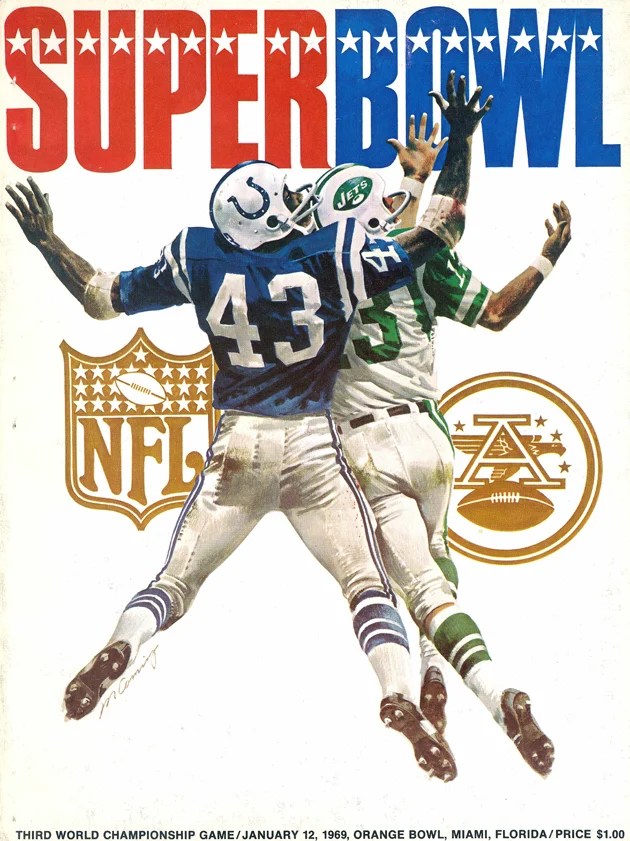
The Super Bowl: A Simple Name With A Common Meaning
So, yes, according to Hunt himself the name of the most popular sporting event in America unconsciously was inspired by a toy for children ages five and up. Regardless of how silly or simplistic this title of the Pro Football Championship Game sounds, it is a label that all people in North America instantly recognize. Whether they’re a die hard football fan or haven’t watched a minute of sports in their lives, the overwhelming majority of people know pretty instantly what the Super Bowl is. Perhaps this was Rozelle and Hunt’s original goal: To come up with a universal designation that most could understand and identify with, even if they thought it would come with more robust wording. Today, the Super Bowl represents more than just a game. Rather, it is a defining event in American culture, something that all citizens can celebrate, appreciate, and enjoy. That might not have been possible without its silly but distinguishable name. Thank you Wham-O.
 Yankee In Exile
Leave a comment