
Tales From Spring Training, Vol. 3
Wait….Did This Really Happen?
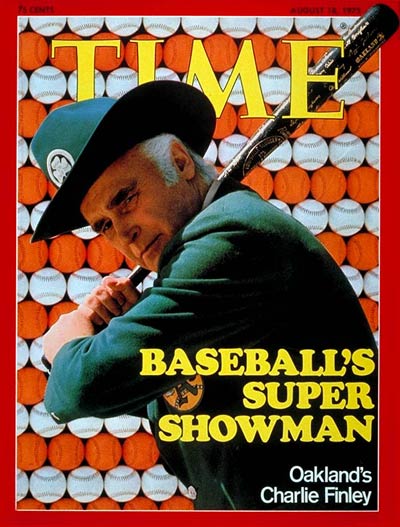
Indeed, at one point in MLB history, changing the color of a standard baseball from white to orange was proposed. Yes, I realize that seems utterly ridiculous and silly enough to be the punchline of a baseball themed episode of a bad TV show. However, before we delve into the reasons and rationale behind the offered switch, first let us turn our attention to the eccentric man who, almost singlehandly, was the proponent of it: Athletics owner Charlie Finley.
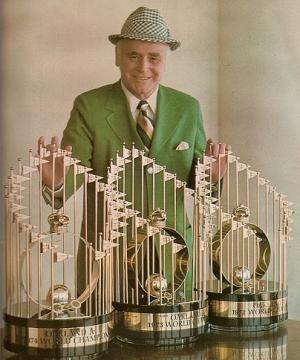
Charles Oscar Finley
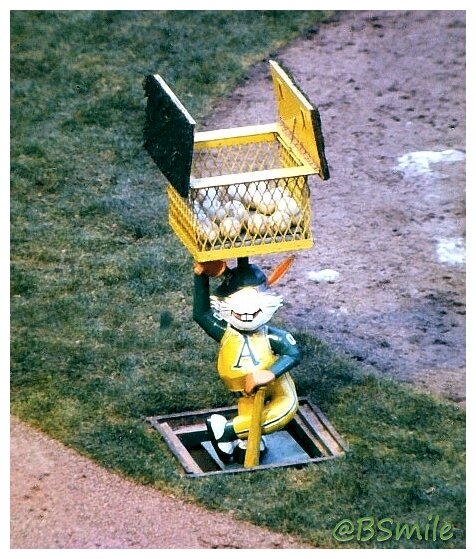
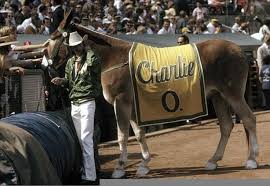
That was the full name of the man who owned the Kansas City/Oakland A’s from 1960 to 1980. The man who made his fortune writing some of the first medical insurance policies, made the controversial decision to move the A’s from their Missouri home in 1968. When he did, Major League Baseball felt so bad for Kansas City that they immediately promised them an expansion team in 1969 (the Royals). The 1960s and 1970s were chock full of outrageous owners (think Bill Veeck and George Steinbrenner), but Finley may have taken the cake. While the A’s were still in Missouri, he incorporated a live mule, who he named “Charlie O” as their official mascot. He also had a mechanical rabbit named Harvey built into the ground to deliver baseballs to the home plate umpire. Once the A’s moved to Oakland, Finley’s fashion sense made them one of the most recognizable sports teams in America with their white shoes and green and gold uniforms. He also offered any player who would grow a handle bar mustache $300, which was a lot more money back then than it is today. Finley then tried to tempt star pitcher Vida Blue with $2,000 to legally change his name to “True Blue” in order to market him in a more effective way.
During the mid-1970s, Finley unsuccessfully lobbied the American League to institute a “designated runner” and signed former track star Herb Washington for that purpose. However, by far Finley’s most scandalous antic was during the 1973 World Series. In Game 2, second baseman Mike Andrews made two costly errors. The next day, The A’s owner attempted to put the disgraced infielder on the Disabled List. The situation got so heated that it led to manager Dick Williams resigning after his team had won the World Series! Perhaps pitcher Mike Torrez perfectly summed up Finley’s chicanery when he nicknamed him “The Wizard of Odd.”
Orange Baseballs-The Rationale
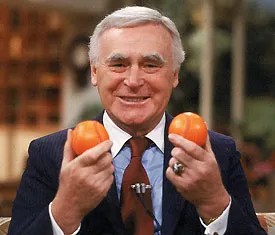
Knowing this information, it hardly seems far-fetched that it was Charlie O. Finley who first proposed the idea for baseballs to be dyed orange at the 1963 owner’s meeting (he also pitched the idea of green bats around the same time). The A’s owner argued that the more vibrant balls would be easier for batters and fielders to see especially during night games. As Exhibit A, he mentioned a play in that year’s World Series, in which Joe Pepitone of the Yankees misplayed a ball in the outfield because he lost track of it. However, Finley found that his idea was originally laughed right out of the room. One has to remember that in 1963, “Charlie O” was a fairly new owner of a franchise that had seen much better days and his ideas would, naturally, not be taken too seriously.
Fast forward ten years, though, and fate was telling a much different story. By the beginning of 1973, Finley had moved his team to California, and there, they reached completely new heights. They had just won the 1972 World Series and their roster boasted stars like Reggie Jackson, Catfish Hunter, Rollie Fingers, Sal Bando, and the aforementioned Vida Blue. By this time, the former insurance magnate had a fair amount of clout and influence, and the American League was more receptive to his brainchildren. The powers that be told Finley that if he could find a team willing to play an exhibition game against the A’s using orange baseballs, that game would be permitted as an official spring training game in 1973. The opportunity was finally here, the only question became: what other team would actually want to entertain this zany scheme?
Orange Baseballs-The Execution
The original pitch for the very first “orange ball game” was for it to take place during the annual spring training game between the A’s and their National League neighbors, the San Francisco Giants. However, the senior circuit (NL) refused to allow one of its teams to play the role of guinea pigs in such a game. Instead, it was the American League’s Cleveland Indians that agreed to play orange ball with the A’s. Unlike the Athletics, the Indians weren’t exactly in their prime, and had not played in a World Series for nearly 20 years. The matchup took place on March 29, 1973 at the A’s preseason home of Mesa, Arizona.
Interestingly enough, Finley was not even in attendance to witness his brainchild come to fruition, seeing as he was traveling in Chicago at the time. Baseball commissioner Bowie Kuhn was, however, and the game he took in was very high scoring. In what ended as a 11-5 Indians win, one thing was for certain: “Charlie O” was correct that hitters could see the ball in a better way and that resulted in an above average amount of hits and runs. A few days later, these orange balls were given another try on April 2nd in a game between the A’s and Angels in Palm Springs, California, a 8-3 Angels triumph. And…..that’s it. These were the only two times baseballs of this color were used in any capacity despite Finley continuing to push for their inclusion in the years to come. But why? What was so terrible about the concept of a more vibrant baseball? Did the players really hate them that much? We’re about to find out…..
The Complaints
Immediately, there were many objections to this profound change. Indians ace Gaylord Perry protested that the texture of the balls were too slippery and Catfish Hunter stated that it was almost impossible to throw a breaking ball because of the grip. Well, when you have two of the most significant pitching stars of the day, both future Hall of Famers, disliking an idea, it’s pretty safe to say that suggestion faces an uphill climb. They weren’t alone however. Another pitcher, the Angels’ Clyde Wright claimed that the orange balls “looked like Easter eggs” and that he couldn’t really view them as legitimate. Yankees scout Roy Hamey said that “they looked like balloons” and expressed doubt at the long term sustainability of them. However, perhaps the most damning indictment of Finley’s brainchild was the complaint that involved making money. Commissioner Kuhn observed that the experimental ginger balls were much more difficult to autograph than regular baseballs because of their slippery surface. Maybe we’ll never know what exactly was the most moving factor behind the banishment of the orange balls, but it seems clear that the MLB had multiple reasons to pull the plug on this project after just two exhibition games.
Conclusion
Charlie Finley will forever be most known for his eccentric ideas as an owner and scores of people today look back on his legacy and seem to roll their eyes. However, for all his proposals that didn’t work, he had many that did. Even though the Yankees had the very first designated hitter, Finley was instrumental in the concept and its further adoption. As it also turns out, the A’s spirited uniforms made a ton of money when being sold at merchandise stands, so other teams followed suit with their designs. Do you like teams from the American and National Leagues playing each other during the regular season? Well, Finley came up with that recommendation too, but died just before the schedule was adapted to make room for this new “Interleague Play”. He even hired a young MC Hammer as a bat boy after seeing him dancing in the parking lot of Oakland Coliseum. Let’s not lose sight of the fact that the A’s won three consecutive World Series under his leadership as well. Simply put, for all of his faults, Charles Oscar Finley just wanted the game of baseball to develop into the best version of itself, coming up with some zany but practical ideas in the process. Honestly, he should be put in the Hall of Fame.
 Yankee In Exile
Leave a comment